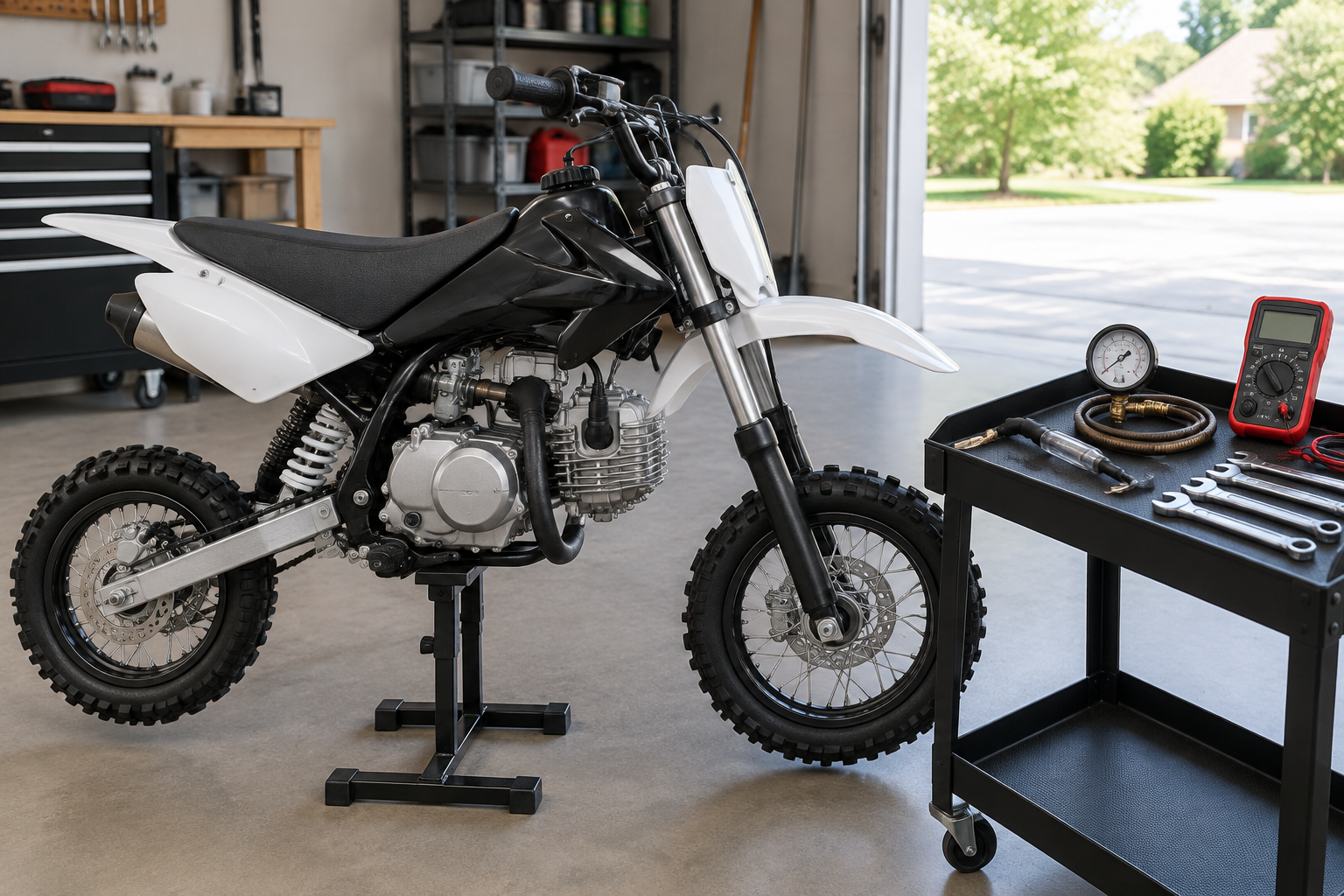
Pit Bike Won't Start: Fuel, Spark, and Compression Checks
The short answer: First decide whether the engine will not turn, turns slowly, or cranks normally but will not fire. A normally cranking gasoline engine needs the right fuel, spark, compression, and timing. Do not keep replacing carburetor or ignition parts until one of those branches actually fails a test.
This guide applies to common gasoline pit bikes. For an electric bike that will not power on, use the battery, fuse, interlock, controller, and manufacturer diagnostic path instead.
Safety First
Work outdoors or in a well-ventilated area. Keep fuel away from sparks and hot surfaces, support the bike securely, place the transmission in neutral, and keep hands and clothing away from moving parts.
Stop if fuel leaks, wiring melts, the battery is damaged, the engine is seized, or the starting system behaves unpredictably.
What You Need
- Exact owner or service manual and wiring diagram
- Basic hand tools
- Flashlight and clean rags
- Approved spark tester
- Digital multimeter when the manual provides tests
- Fuel-safe container
- Correct replacement spark plug for comparison, if needed
- Compression gauge only when you can follow the model procedure
Diagnostic Order
1. Confirm the Controls
Check neutral, fuel valve, choke or enrichener, run or kill switch, key, tether, side-stand or brake interlocks where fitted, and the model's starting sequence. A switch left in the stop position can look like a mechanical fault.
Use the correct cold- or warm-start method. Avoid repeated long cranking that overheats the starter or floods the engine.
2. If the Engine Will Not Turn
Check whether the kickstarter, starter motor, or crankshaft can move normally. A weak battery, loose terminal, failed fuse, starter relay, damaged starter drive, seized engine, or internal mechanical fault can stop cranking.
Do not force a locked kickstarter. Check oil level and arrange inspection if the engine cannot rotate through its normal cycle.
3. If It Cranks Slowly
Inspect battery condition and terminals on electric-start models, then test to the manual. Check the starter cable, grounds, relay, and starter motor only after the battery and connections are known good.
Slow cranking can weaken spark and compression readings. Fix cranking speed before diagnosing a normally rotating engine.
4. Check the Spark Plug Condition
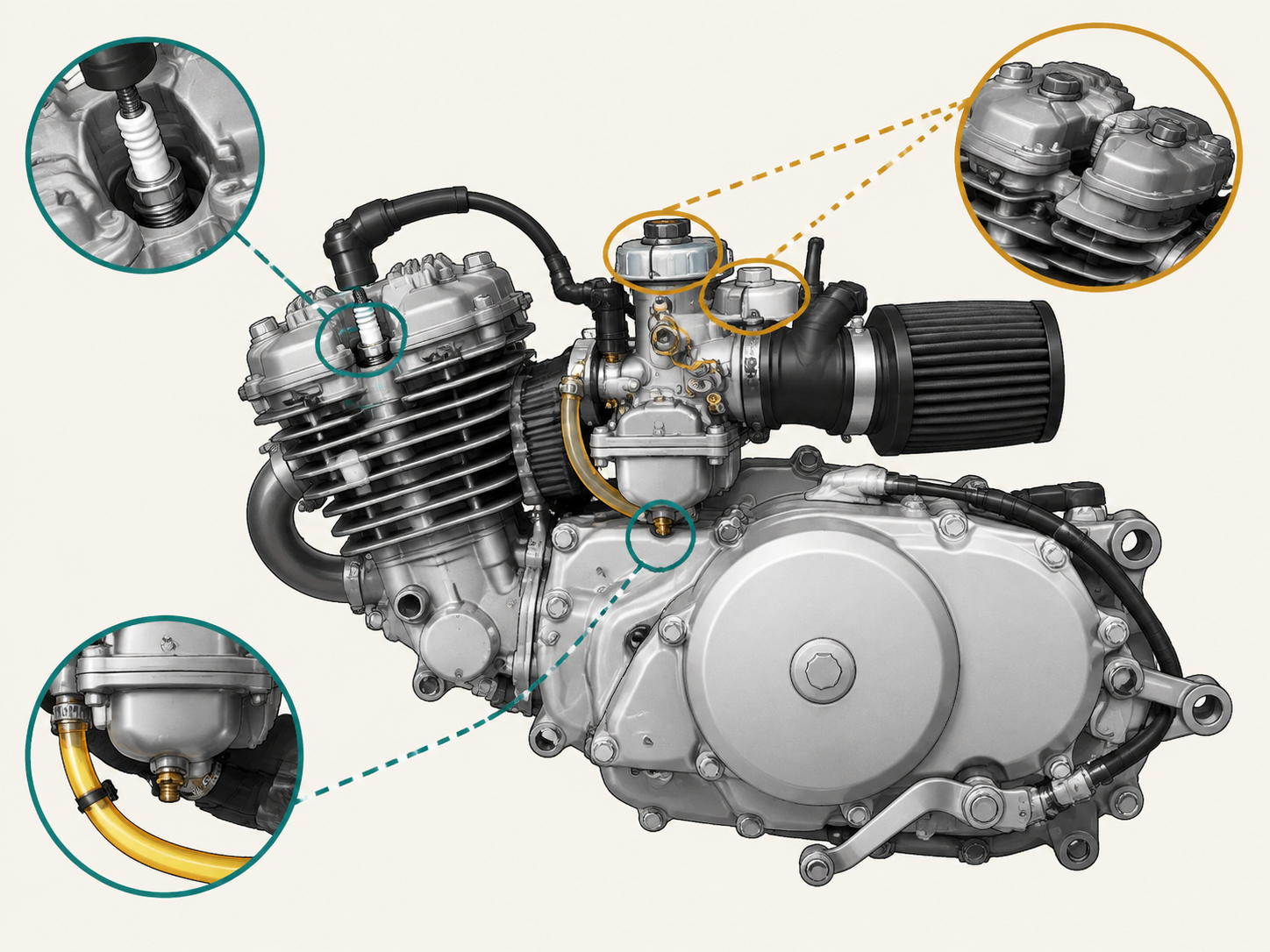
Remove the plug using the manual's procedure. A dry plug after repeated starting can point toward missing fuel, while a wet plug can indicate flooding, weak ignition, or poor combustion.
Inspect plug type, gap, fouling, cracks, and damage. Install the correct plug and use an approved spark tester; the no-spark guide covers the electrical branch.
5. Confirm Fuel Quality and Flow
Use fresh fuel of the type specified by the manufacturer. Inspect the cap vent, petcock, filter, hose, bowl, and carburetor vents for restriction, water, varnish, debris, or leaks.
If fuel reaches the bowl but the plug remains dry, inspect the choke and pilot circuit. If the plug is wet, follow the manual's flooded-engine procedure rather than adding more fuel.
6. Check the Intake
Inspect the air filter, airbox, intake boot, manifold, clamps, and vacuum ports. A severely blocked filter, open intake, loose carburetor, or cracked manifold can prevent reliable starting.
Do not run the engine without a properly fitted filter. Repair intake damage before changing jets or mixture settings.
7. Check Compression and Valve Condition
If fuel and spark are present, check valve clearance, cam timing, and compression to the service manual. Tight valves, incorrect timing, worn rings, leaking valves, or a head-gasket fault can prevent starting.
Compression readings depend on test method, cranking speed, throttle position, decompression system, and engine temperature. Use the model's limit, not a number from another pit bike.
8. Recheck Timing and Recent Work
If the problem began after valve, flywheel, stator, carburetor, engine, or wiring work, inspect that area first. Verify cam timing, flywheel key, pickup position, grounds, connector pinout, fuel-line routing, and installed part numbers.
A connector that fits or a part advertised for a pit bike can still be electrically or mechanically incompatible.
Symptom Guide
| Symptom | First branch |
|---|---|
| No crank or locked kickstarter | Battery or starter system; mechanical rotation |
| Cranks slowly | Battery, terminals, grounds, starter circuit |
| Cranks normally, plug dry | Fuel flow, choke, pilot circuit |
| Cranks normally, plug wet | Flooding, spark strength, compression, timing |
| Starts with choke, then dies | Pilot circuit, fuel flow, intake leak |
| Backfires but will not start | Ignition or cam timing, lean mixture, valve condition |
When to See a Mechanic
Seek qualified help when the engine will not rotate, compression is below the model limit, cam timing is uncertain, fuel leaks persist, the harness is damaged, or diagnosis requires flywheel, stator, cylinder-head, or internal engine work.
Do not test-ride until the cause is corrected and the bike passes the pre-ride safety checklist.
FAQ
Should I replace the carburetor first?
No. Confirm fuel flow, pilot-circuit condition, intake sealing, spark, compression, and timing before replacing a carburetor.
Can a weak battery cause a no-start on a kick-start bike?
It depends on the ignition and electrical design. Use the wiring diagram; some systems can spark independently, while others depend on battery power or interlocks.
Why does the plug keep getting wet?
Possible causes include flooding, choke problems, excessive fuel level, weak spark, poor compression, or incorrect timing. Drying the plug alone will not repair the cause.
What if the bike starts and then dies?
Use the starts-then-dies diagnostic guide, which focuses on tank venting, fuel flow, the pilot circuit, intake leaks, heat-related spark faults, and valve clearance.
Evidence and Sources
- Use the Honda Powersports owner-manual library for exact-model starting and troubleshooting procedures on supported Honda models.
- The Yamaha TT-R110E owner manual is an official model-specific starting, fuel, ignition, and troubleshooting reference.
Starting sequence, plug, electrical limits, valve clearance, compression, and timing are model-specific.