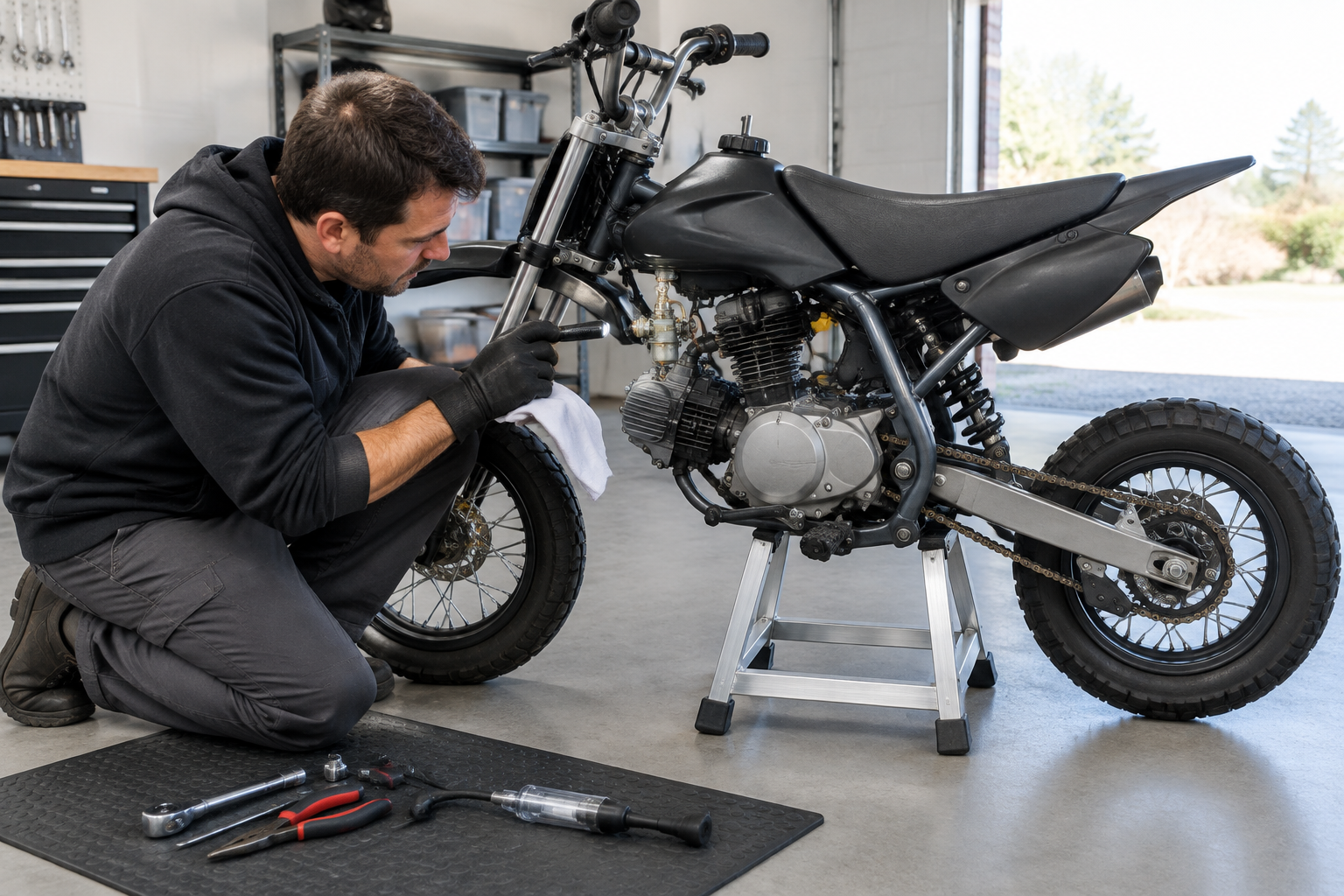
Pit Bike Starts Then Dies: Diagnosis Guide
The short answer: If it dies as the choke comes off, inspect fuel flow, the pilot circuit, and intake leaks. If it runs for several minutes and then stops, check tank venting, fuel delivery, ignition components that fail hot, and valve clearance. Change one thing at a time so the symptom still points to the cause.
This guide covers common carbureted gasoline pit bikes. Stop if fuel leaks, wiring overheats, the engine loses compression, or the exact manual is unavailable for an internal adjustment.
Match the Symptom
| What happens | First checks |
|---|---|
| Starts only with choke, dies when choke is removed | Warm-up, pilot jet, mixture baseline, intake leak, low fuel level |
| Starts, dies when throttle opens | Fuel flow, blocked vent, main transition, slide or cable, ignition under load |
| Runs for minutes, then dies | Tank vent, restricted petcock or filter, coil or pickup heat fault, valve clearance |
| Dies when throttle closes | Idle speed, pilot circuit, cable, slide, intake leak |
| Restarts after sitting | Vent restriction, heat-related ignition fault, valve clearance, fuel boiling |
These patterns overlap. Confirm whether the plug is wet or dry and whether spark remains immediately after the stall before choosing a branch.
What You Need
- Exact owner or service manual
- Basic hand tools
- Flashlight and clean rags
- Approved spark tester
- Fuel-safe container
- Replacement fuel line or filter only when the exact size and routing are known
- Carburetor cleaner and compressed air only when the carburetor maker permits them
- Eye protection and fuel-resistant gloves
Work outdoors or in a well-ventilated area away from flames, sparks, and hot exhaust parts.
Diagnostic Order
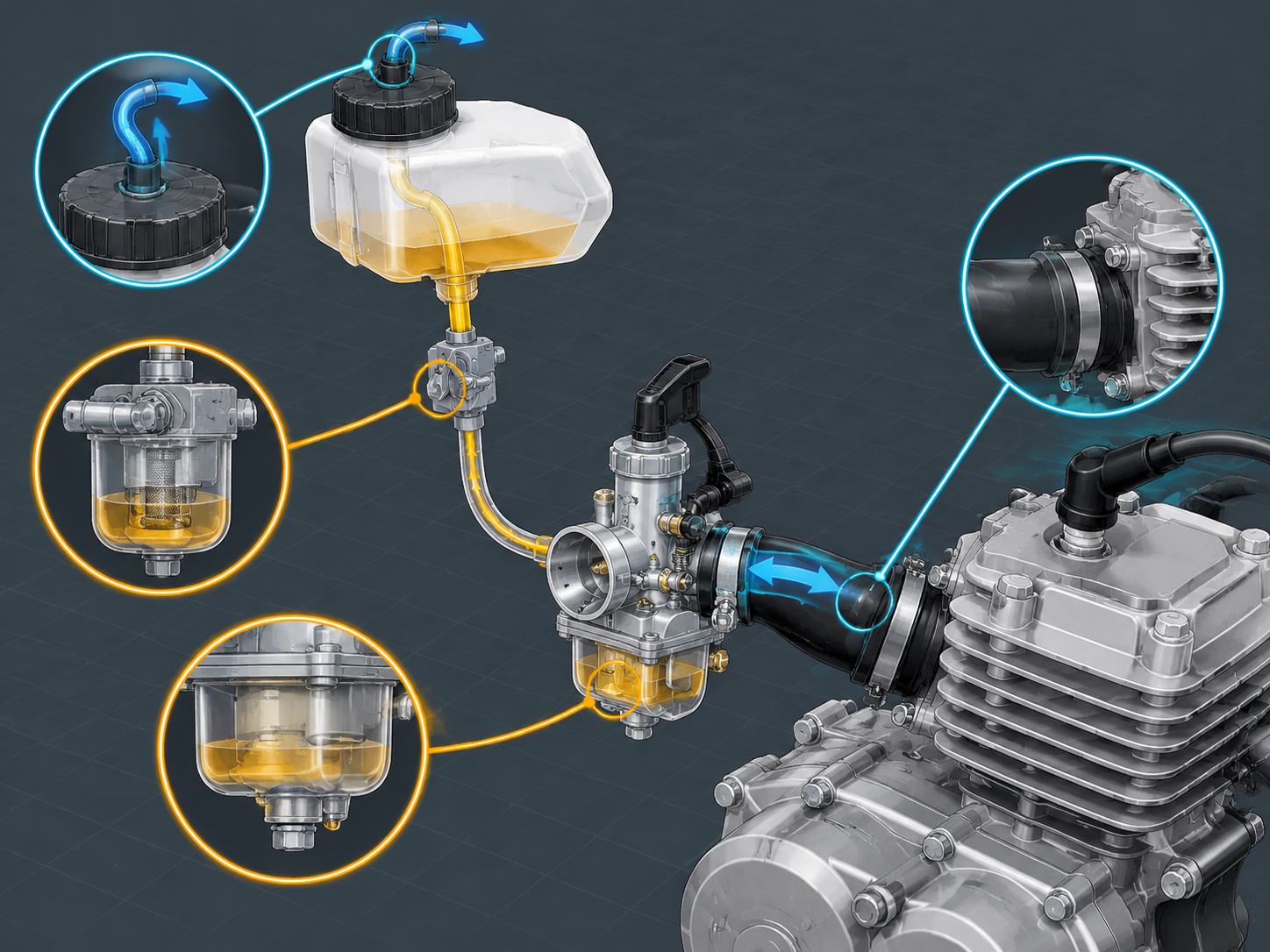
1. Check Starting Technique and Choke
Use the cold- and warm-start sequence in the manual. A cold engine may need choke temporarily, while a warm engine that still needs full choke often has a fuel or intake problem.
Confirm the choke plate or enrichener moves through its full range. A damaged cable or plunger can leave the circuit partly open or closed.
2. Open the Tank Vent Path
A blocked cap vent can let the engine run until vacuum slows fuel flow. When the symptom occurs, follow the manual's safe vent check and listen for an unusual rush of air when opening the cap away from ignition sources.
Inspect vent hoses for kinks, mud, pinching, and incorrect routing. Do not drill or modify a cap without manufacturer guidance.
3. Confirm Fuel Reaches the Carburetor
Turn the fuel valve off before disconnecting anything. Inspect the petcock, hose, filter, and bowl for restriction, stale fuel, water, debris, or a pinched line.
Use the manual's flow procedure and collect fuel safely. Replace cracked or hardened hose and route it away from heat and sharp edges.
4. Inspect the Pilot Circuit
A restricted pilot jet or passage is a common reason a bike starts on choke but will not idle. Remove and clean the carburetor according to its documentation; do not force wire through calibrated jets.
Check the float and needle valve for sticking, and confirm the bowl vents are open. Reinstall the documented jet sizes and baseline settings before tuning.
5. Check for Intake Leaks
Inspect the manifold, carburetor mount, clamps, vacuum ports, gaskets, and airbox connection. A crack or loose mount can lean the mixture most noticeably at idle.
Do not spray flammable chemicals around a running engine to search for leaks. Inspect physically or use a safe method specified by the service manual.
6. Set Idle and Cable Free Play
Confirm the throttle slide closes and the cable has the specified free play at every handlebar position. A tight cable or sticking slide can make adjustment inconsistent.
Warm the engine only as directed, then set idle and mixture to the carburetor's procedure. If a stable setting falls outside the normal adjustment range, return to fuel flow, pilot circuit, float level, and intake leaks.
7. Check Spark Immediately After It Dies
Use an approved spark tester away from fuel. If spark disappears only when hot, inspect the plug cap, coil, pickup, stator, grounds, kill circuit, and connectors using the exact test limits.
The no-spark diagnosis guide provides the electrical sequence. Do not replace the ignition module before checking simpler faults.
8. Check Valve Clearance and Compression
Tight valves can reduce compression as the engine warms and can mimic fuel or ignition trouble. Check clearance only when the engine is at the specified temperature and timing position.
If compression is low, valve timing is uncertain, or the clearances repeatedly change, stop and arrange mechanical inspection.
Safety
- Work outdoors or in a well-ventilated area and keep fuel away from ignition sources.
- Turn the fuel valve off before disconnecting a line or opening the carburetor.
- Use an approved spark tester away from the plug hole and spilled fuel.
- Support the bike securely and keep hands, tools, and clothing away from moving parts.
- Stop if the bike leaks fuel, overheats, loses compression, or stalls unpredictably under load.
When to See a Mechanic
Seek qualified help for persistent fuel leaks, damaged carburetor castings, low compression, incorrect cam timing, repeated overheating, internal engine noise, or electrical faults that require flywheel or stator removal.
Do not continue riding a bike that stalls unpredictably. A stall while crossing terrain or approaching traffic can create a control hazard even when the bike restarts later.
FAQ
Why does it run only with the choke on?
The pilot circuit may be restricted, fuel level may be low, or unmetered air may be entering the intake. Check those before installing a larger jet.
Why does it die after five or ten minutes?
Check the tank vent and fuel flow first, then test spark immediately after the stall. Heat-related ignition faults and tight valves can also appear only after warm-up.
Should I turn the mixture screw until it stays running?
No. Start from the exact baseline and fix restrictions, leaks, float problems, cable faults, or mechanical issues before tuning.
Can stale fuel cause this symptom?
Yes. Old or contaminated fuel can restrict small carburetor passages and change combustion. Drain and dispose of fuel according to local rules and the bike's service procedure.
Evidence and Sources
- Use the Honda Powersports owner-manual library for exact-model starting and troubleshooting procedures on supported Honda models.
- The Yamaha TT-R110E owner manual is an official example of model-specific choke, carburetor, idle, valve, and troubleshooting guidance.
Jet sizes, mixture baselines, idle speed, valve clearance, compression limits, and electrical tests are model-specific.