Pit Bike Carburetor Adjustment: Tuning Guide
The short answer: Do not tune around a dirty pilot jet, restricted fuel flow, intake leak, incorrect float level, damaged choke, tight valve, or weak ignition. Record the starting settings, change one item at a time, and use the exact carburetor and engine manual for baseline turns, idle speed, float height, needle position, and jet sizes.
This guide applies to common gasoline pit bikes with a conventional carburetor. It does not apply to fuel injection or electric bikes.
Before You Turn a Screw
Confirm the engine starts with fresh fuel, the tank vent and petcock flow, the air filter is correctly serviced, the intake boot is sealed, the exhaust is not blocked, and the spark plug and valve clearance meet the manual. Carburetor adjustment cannot compensate safely for those faults.
Identify the carburetor maker and model from its casting or label. A screw on the engine side of the slide often meters fuel, while a screw on the air-filter side often meters air, but the exact design determines which direction richens the mixture.
What You Need
- Exact engine and carburetor documentation
- Screwdrivers that fit without damaging the slots
- Tachometer if the manual specifies an idle speed
- Clean fuel-safe container and rags
- Eye protection and fuel-resistant gloves
- Fire extinguisher suitable for the work area
- Notebook for baseline settings and each change
Work outdoors or in a well-ventilated area away from flames, sparks, heaters, and hot exhaust parts.
Diagnostic Tuning Order
1. Record the Baseline
Before adjustment, count and record the existing mixture-screw position only if the manual permits it. Turn a screw gently; seating it hard can damage the tip or carburetor body.
Record the pilot jet, main jet, needle clip, float setting, air-filter setup, exhaust, altitude, temperature, and symptom. Without a baseline, several changes can hide the real cause.
2. Clean the Pilot Circuit
A bike that will not idle, needs choke when warm, or dies when the throttle closes often has a restricted pilot circuit or fuel-flow problem. Clean the carburetor using the maker's procedure and replace damaged seals rather than forcing wire through calibrated passages.
Confirm fuel reaches the bowl and the tank vent is open. Check for water, debris, varnish, a sticking float, and a blocked bowl vent.
3. Check the Choke and Throttle Cable
Confirm the choke fully opens and closes, and that a cable-operated enrichener has the specified free play. A partly engaged choke can make a warm engine run rich.
Set throttle-cable free play to the manual and turn the handlebar fully left and right. The idle must not rise because the cable is tight or routed incorrectly.
4. Warm the Engine Safely
Tune only after the engine reaches the condition specified by the manual. Keep the rear wheel clear, support the bike securely, and avoid prolonged stationary running on an air-cooled engine.
Stop if the engine overheats, leaks fuel, makes mechanical noise, or requires an unsafe throttle opening to stay running.
5. Set Idle Speed
Use the idle-stop screw and specified tachometer procedure. An idle set too high can mask a lean pilot circuit, cable problem, clutch drag, or air leak.
Set the idle only after the basic mechanical and fuel checks pass. Recheck throttle return and handlebar movement afterward.
6. Adjust the Mixture Screw
Start from the model-specific baseline. Make small changes, wait for the idle to stabilize, and look for the smoothest stable idle before resetting idle speed.
If the best setting falls outside the manual's normal adjustment range, stop turning the screw. The pilot jet, float level, air leak, fuel flow, or engine condition likely needs attention.
7. Diagnose by Throttle Range
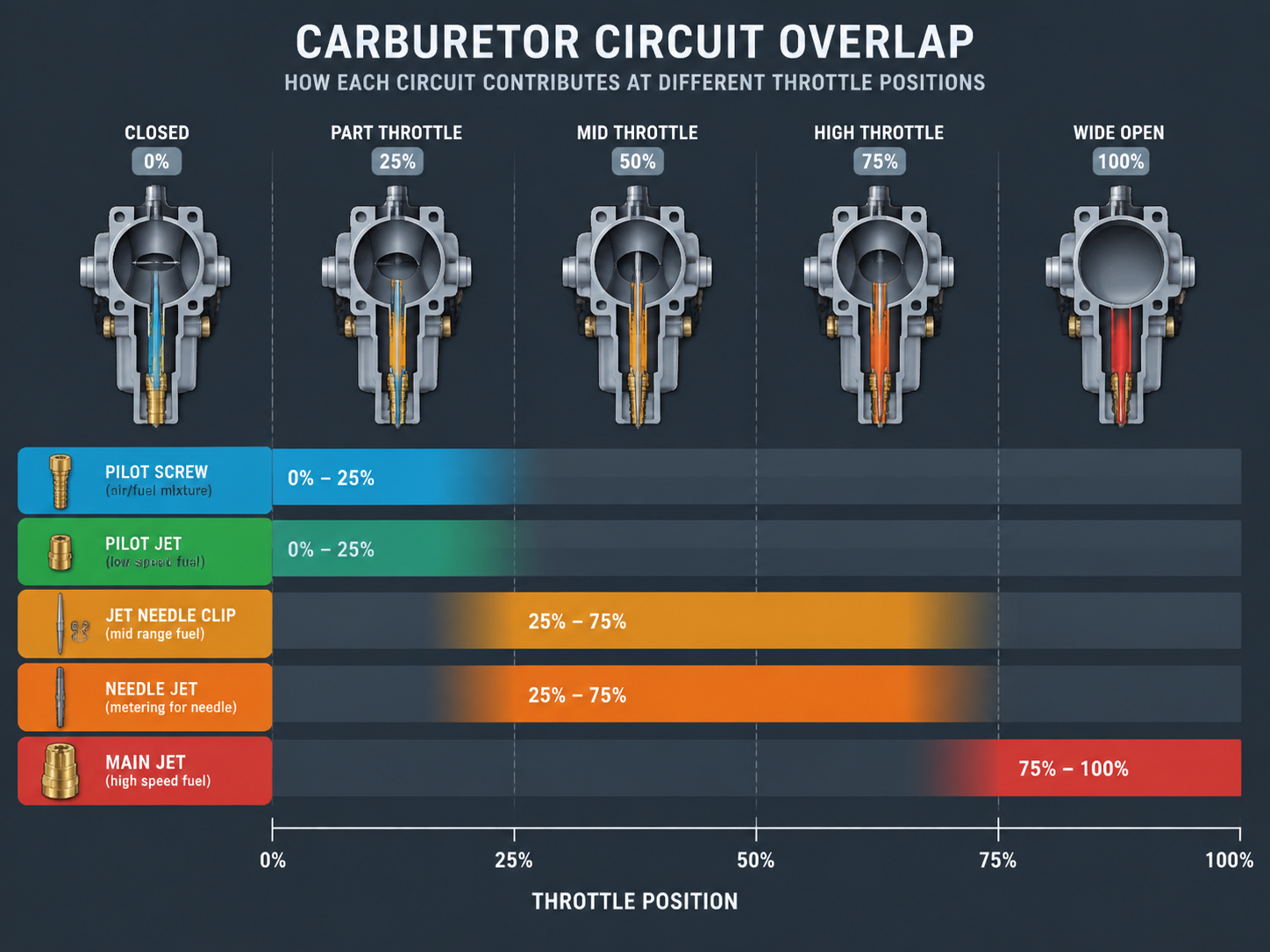
The pilot circuit mainly affects idle and small throttle openings. Needle diameter and clip position influence the middle range, while the main jet matters most at larger openings; overlap varies by carburetor.
Do not change the main jet to fix an idle-only problem. Change one component at a time and use the carburetor maker's tuning chart where available.
8. Recheck After Modifications
An aftermarket exhaust, air filter, engine kit, altitude change, or fuel change can alter mixture requirements. That does not prove the engine needs a larger jet in every case.
Inspect for intake leaks and confirm the exact engine and carburetor combination before selecting parts. A carburetor bore or jet kit marketed for a pit bike is not universally compatible.
Symptom Guide
| Symptom | Check first |
|---|---|
| Starts with choke, dies without it | Pilot circuit, fuel flow, intake leak, warm-up state |
| Rich smell, smoke, or fouled plug | Choke, float or needle valve, filter restriction, jetting |
| Hanging idle | Intake leak, tight cable, lean pilot setting, slide movement |
| Bog just off idle | Pilot circuit, accelerator system if fitted, needle transition |
| Breaks up at large throttle | Main jet, fuel flow, ignition under load, float level |
These symptoms overlap. Confirm ignition, compression, valve clearance, and fuel quality before treating every running problem as jetting.
Safety
- Work outdoors or in a well-ventilated area away from flames, sparks, heaters, and cigarettes.
- Let the exhaust and engine cool before removing fuel-system parts.
- Collect fuel in an approved container and clean spills before starting the engine.
- Support the bike securely and keep the rear wheel clear during running checks.
- Stop for a fuel leak, overheating, abnormal engine noise, or a throttle that does not close.
When to See a Mechanic
Stop when fuel leaks from the overflow, the float or needle valve is damaged, adjustment screws are seized, the intake mounting is cracked, or the engine shows low compression, repeated overheating, or valve-related symptoms.
Professional diagnosis is also appropriate when no official baseline exists for an aftermarket engine and carburetor combination. Random jet changes can make the bike unreliable or dangerously lean.
FAQ
How many turns out should the mixture screw be?
Use the baseline for the exact carburetor and engine. There is no universal setting for every PZ, PE, VM-style, or other pit bike carburetor.
Which way makes the mixture richer?
It depends on whether the screw meters fuel or air. Identify the screw from the carburetor documentation before adjusting it.
Why does the bike only run with the choke on?
Common causes include a restricted pilot circuit, low fuel level, blocked fuel flow, or an intake leak. Check those before installing a larger jet.
Should I buy a larger carburetor?
Not until the existing system is correctly identified and diagnosed. Bore size, manifold fit, cable end, choke, jetting, clearance, and engine requirements must all match.
Evidence and Sources
- Use the Honda Powersports owner-manual library for exact-model starting, idle, fuel, and service procedures on supported Honda models.
- The Yamaha TT-R110E owner manual is an official example of model-specific carburetor, idle, choke, and maintenance guidance.
Baseline settings, idle speed, float height, jet sizes, screw direction, and service limits are carburetor- and engine-specific.