Pit Bike Battery Not Charging: Diagnosis Guide
The short answer: First identify whether the bike has a small 12V starting battery or an electric traction battery. Check the correct charger, fuse, terminals, connectors, and battery condition before blaming the stator or controller. Stop if the battery is swollen, leaking, unusually hot, physically damaged, or specified service information is unavailable.
Identify the Charging System
A gas pit bike may use a small battery for electric start and lights while the engine's stator and regulator handle charging. An electric dirt bike or mini bike uses a higher-energy traction battery, a dedicated charger, and a controller or battery-management system.
Do not apply gas-bike tests to a traction battery. Record the bike model, battery label, voltage, chemistry, charger model, connector, and fuse rating before testing or ordering parts.
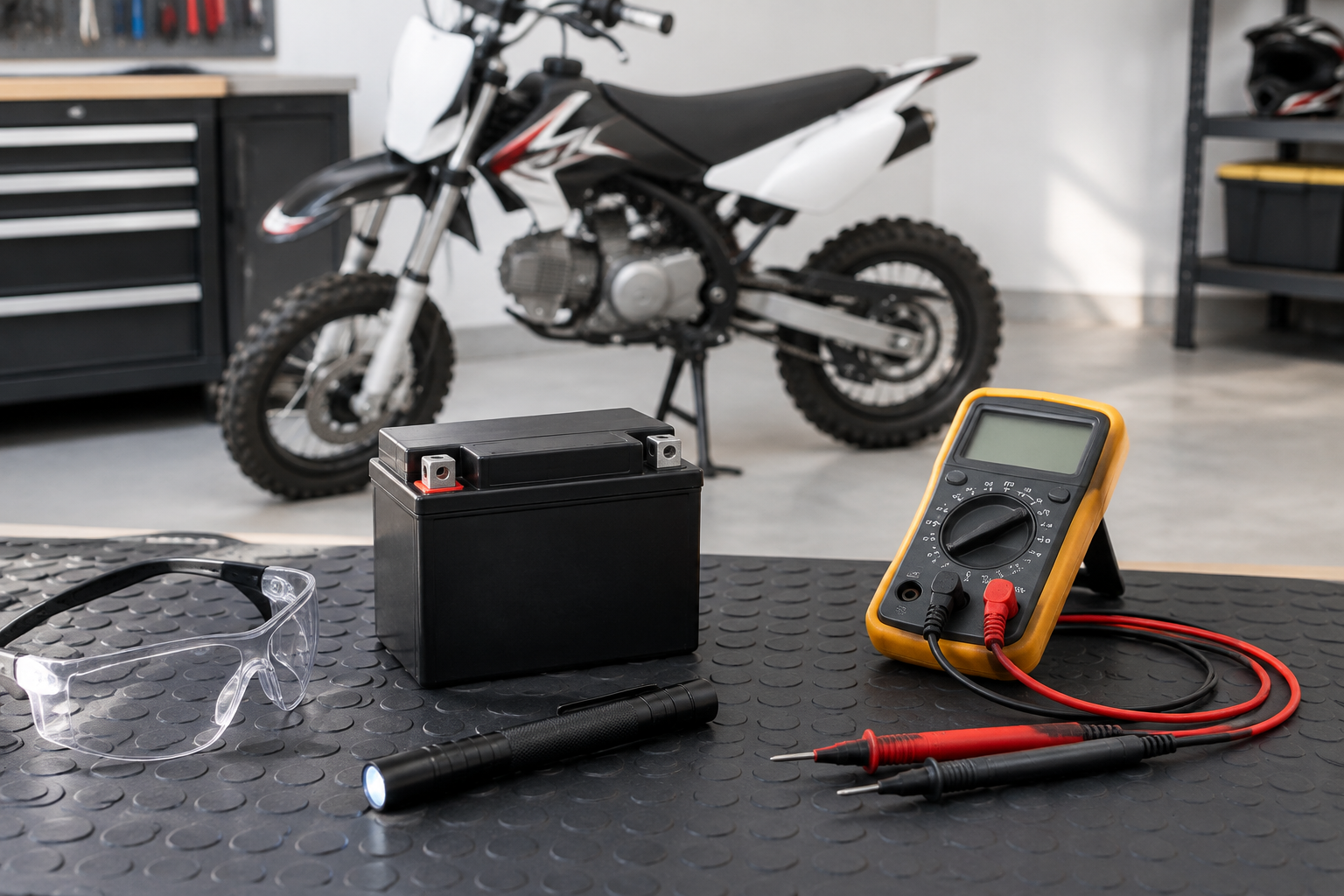
What You Need
- The exact owner or service manual
- Eye protection and insulated gloves appropriate to the battery system
- A digital multimeter rated for the system, if the manual provides test points and limits
- A flashlight and clean cloth
- The original or manufacturer-approved charger for an electric bike
- A known-good fuse of the exact specified type and rating, only if replacement is needed
Do not open a sealed traction-battery pack or bypass a battery-management system. High-current batteries can cause fire, burns, or electric shock even when the bike is switched off.
Diagnostic Order
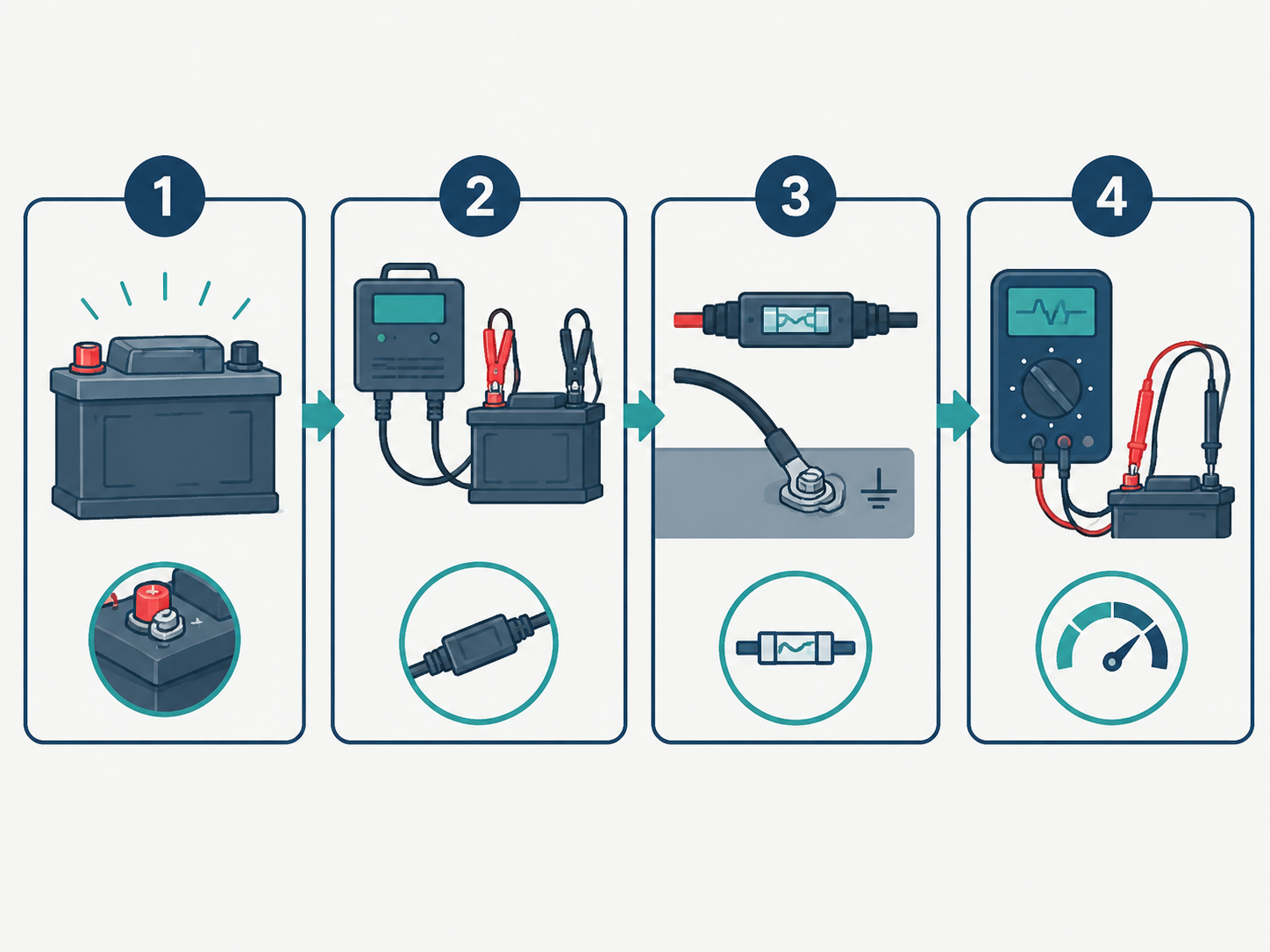
1. Confirm the Symptom
Note whether the battery will not accept a charge, charges but quickly goes flat, powers lights but not the starter, or causes the charger to show an error. Those symptoms point to different parts of the system.
Confirm that the key, run switch, charge-port cover, interlock, and charger sequence match the manual. Some electric bikes will not charge when a connector or temperature condition is outside the permitted range.
2. Inspect Before Measuring
Switch the bike off and disconnect it as the manual directs. Look for a swollen case, cracks, leaks, melted insulation, corrosion, loose terminals, pin damage, water entry, or a burnt smell.
Do not charge or ride with visible battery damage. Move away from combustible material only when it is safe to do so, and follow the manufacturer or local fire-service guidance for a damaged lithium battery.
3. Check the Charger or External Power
For an electric bike, confirm the wall outlet works and the charger model matches the battery label. Inspect the cable, plug, charge port, and indicator behavior; do not substitute a charger merely because the connector fits.
For a gas bike, confirm the battery is the specified type and that any external maintainer uses the correct charging mode. A charger test can help separate a discharged battery from an engine-side charging problem, but use the battery maker's procedure.
4. Check the Fuse and Connections
Locate the charging or main fuse using the wiring diagram. Replace a blown fuse only with the specified type and rating; a larger fuse can leave the wiring unprotected.
Clean and tighten battery terminals and grounds only after isolating the system as directed. A loose ground, corroded connector, pushed-back pin, or damaged charge-port contact can interrupt charging even when the battery itself is serviceable.
5. Test the Battery to the Manual
If the manual gives a safe test procedure, compare the resting voltage and loaded behavior with its limits. Voltage alone does not prove capacity or battery health, and a battery can show voltage while failing under load.
Do not use universal numbers from another pit bike. Battery chemistry, cell count, temperature, recent charging, and meter accuracy all affect the reading.
6. Check Engine-Side Charging on a Gas Bike
When a gas bike starts but does not replenish its small battery, inspect the stator connector, regulator or rectifier, ground points, and wiring. Measure output only at the specified test points, engine speed, meter setting, and limits in the service manual.
A failed stator, regulator, connector, or ground can produce similar symptoms. Do not replace parts until the manual's sequence isolates the fault.
7. Escalate Electric-Bike Faults
If the approved charger and external connections are sound but a traction battery still will not charge, the fault may involve the pack, battery-management system, controller, charge port, or internal wiring. Those parts require model-specific diagnostics and often qualified service.
Do not bridge contacts, bypass an interlock, open the pack, or probe unknown high-current terminals. Ask the seller or manufacturer for warranty and battery-service instructions.
When to Replace the Battery
Replacement is reasonable only after the charger, fuse, connections, and charging source have been checked. Match chemistry, nominal voltage, capacity range, case dimensions, terminal layout, connector, current capability, and manufacturer approval.
The pit bike parts compatibility guide explains why a connector or model name alone does not confirm fit. Record the old battery label and part number before ordering.
Safety
- Keep charging equipment away from fuel, water, heat, and combustible material.
- Do not charge a swollen, leaking, hot, wet, or impact-damaged battery.
- Do not open a sealed traction pack, bridge contacts, or bypass a fuse or battery-management system.
- Use insulated tools and the isolation sequence specified by the manufacturer.
- Keep children and bystanders away from battery testing and charging.
When to See a Technician or Mechanic
Stop and seek qualified help when the battery is swollen, leaking, hot, damaged, wet, or repeatedly blows a fuse. Also stop when the system uses a sealed traction pack, the wiring diagram is unavailable, charging output is outside the manual's limits, or a repaired connection overheats.
Do not continue riding a gas bike with a charging fault if the battery powers required controls or lighting. Do not leave a suspect electric-bike battery charging unattended.
FAQ
Can I use a charger with the same plug?
No. The connector does not establish voltage, current, polarity, chemistry, charging profile, or communication compatibility. Use the charger specified by the bike or battery manufacturer.
Why does the battery charge but go flat quickly?
The battery may have lost capacity, the bike may have a parasitic load, or the charging source may be weak. Test in the order given by the exact manual rather than replacing the battery first.
Can I install a larger fuse?
No. Use only the specified fuse type and rating. A larger fuse can allow wiring or components to overheat before the circuit opens.
Is a battery fault the same on gas and electric pit bikes?
No. A gas bike's small starter battery and an electric bike's traction battery use different charging systems, hazards, and diagnostic procedures.
Evidence and Sources
- Use the Honda Powersports owner-manual library for model-specific battery and electrical procedures on supported Honda models.
- The MSF T-CLOCS checklist includes battery terminals, wiring, lights, and visible condition in a pre-ride inspection.
This diagnostic order is general. Voltage limits, charger behavior, fuse ratings, test points, battery chemistry, and replacement procedures must come from the exact bike, battery, and charger documentation.