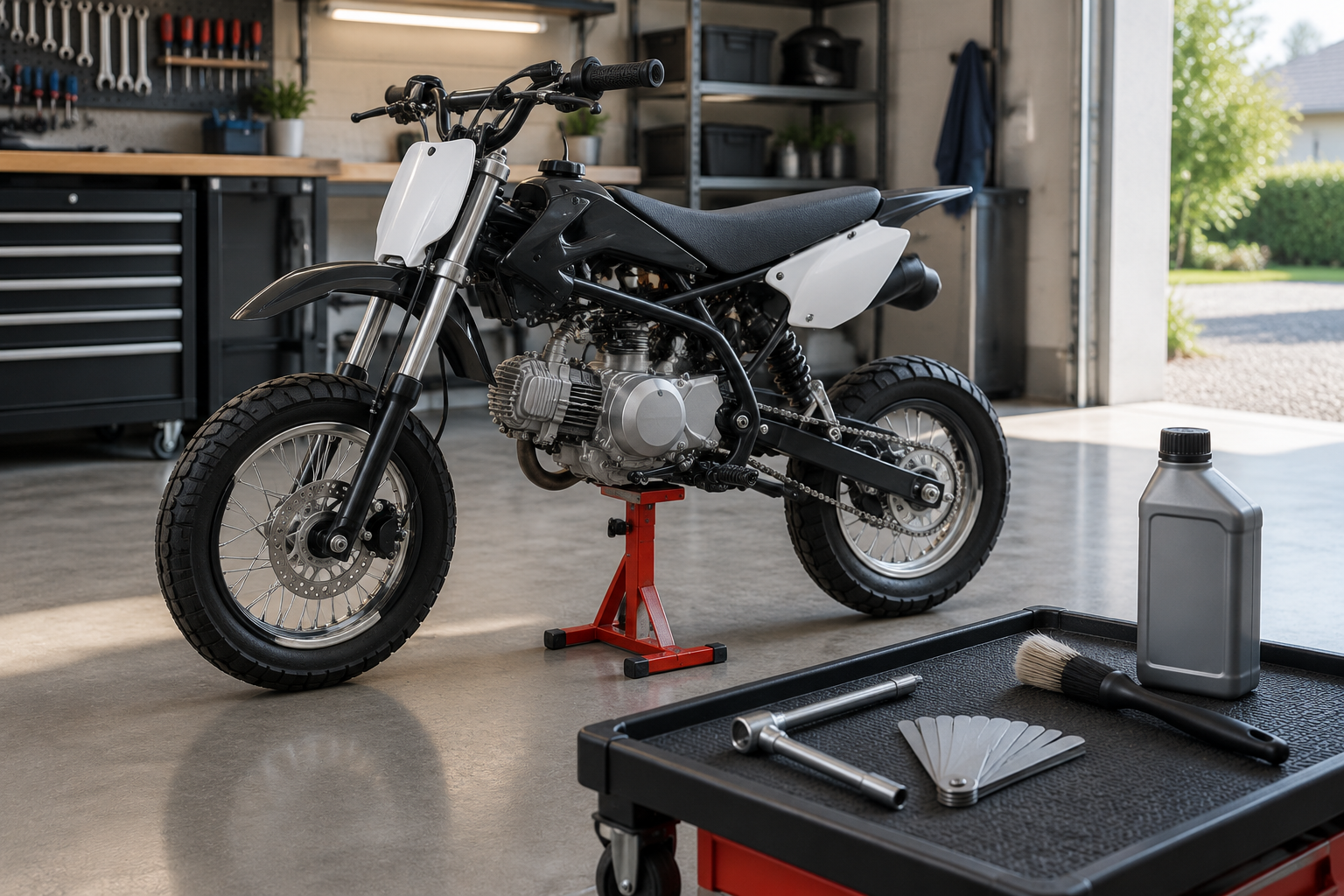
Pit Bike Overheating: Causes, Checks, and Repairs
A pit bike that runs hot can lose power, rattle, stall, or damage its piston and cylinder. Most 110cc-125cc four-stroke pit bikes use air cooling, while some models have an oil cooler or liquid-cooling system.
Do not keep riding while the engine is overheating. Find the cause before returning the bike to service.
What you need
- Owner's manual for the exact bike
- Basic socket and wrench set
- Screwdrivers and pliers
- Spark plug socket
- Feeler gauges
- Chain lubricant
- Engine oil specified by the manufacturer
- Funnel and drain pan
- Replacement spark plug, air filter, or oil filter if inspection shows damage
- Soft brush and compressed air for cleaning cooling fins
- Infrared thermometer, if available
- About one to two hours, depending on the fault
Step by step
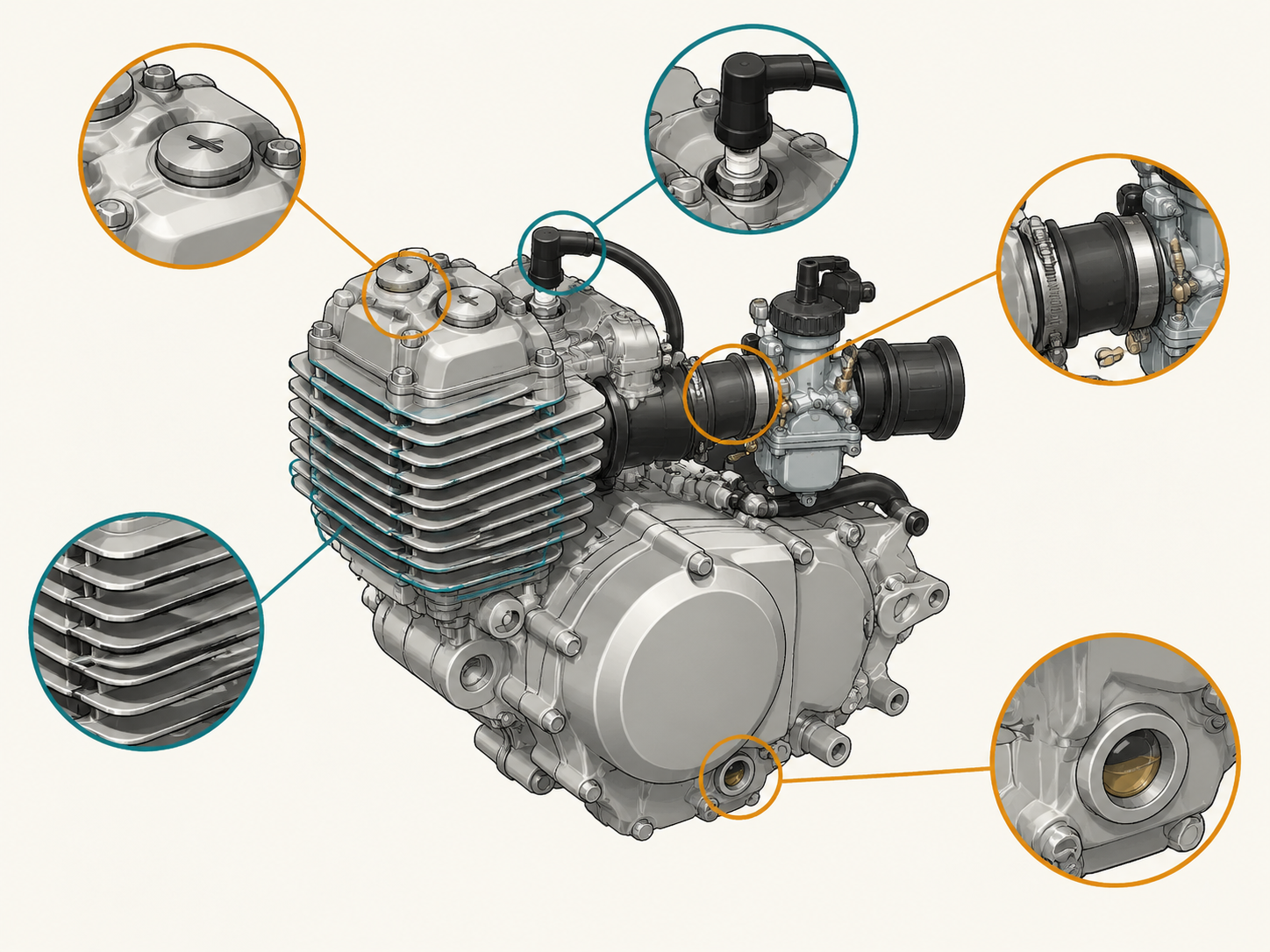
Stop the engine and identify the symptom
Use the kill switch and let the engine cool fully. Record what happened. Overheating under heavy load points toward restricted airflow, low oil, lean fueling, or incorrect ignition timing. Overheating while idling can indicate an obstructed air path, poor carburetor adjustment, or a cooling-system fault.
Look for smoke, oil leaks, a burning smell, loss of power, ticking from the cylinder head, or coolant leaking from a liquid-cooled engine.
Check the oil level and condition
Place the bike upright on level ground and check the oil using the procedure in the owner's manual. Some engines use a dipstick that is checked without threading it in; others use a sight glass or a different method.
The common oil capacity for small pit-bike engines is roughly 0.8-1.2 liters, but confirm the correct capacity and oil grade in your own bike's manual. Do not use capacity alone to determine the final level.
If the oil is low, find the leak before riding. Inspect the drain plug, side-cover gasket, shift shaft seal, countershaft seal, and crankcase for wet oil. Oil that smells strongly of fuel or contains metal particles requires further inspection.
Inspect the cooling fins and engine airflow
Air-cooled engines depend on clean cylinder and head fins. Remove packed mud, grass, and oil-soaked dirt with a soft brush and compressed air. Keep the air nozzle far enough away to avoid bending fins.
Check that plastic shrouds, skid plates, wiring, or aftermarket guards are not blocking airflow. Do not pressure-wash directly into the carburetor, electrical connectors, or engine seals.
Check the air filter
A blocked filter can make the engine run poorly and increase heat. Remove the filter and inspect it for dust, oil saturation, water, or collapse.
Clean or replace it according to the manufacturer's procedure. Foam filters normally need the correct filter oil after cleaning. A damaged or poorly sealed filter can allow dust into the engine and accelerate wear.
Check the carburetor and fuel supply
Make sure the fuel valve is fully open and the fuel line is not kinked. Inspect the tank vent and carburetor bowl for contamination.
A lean mixture can cause high engine temperature, hanging idle, popping on deceleration, and a pale spark-plug insulator. Common causes include a blocked pilot jet, an intake-manifold leak, an incorrectly sized jet, or an air leak around the carburetor.
Do not assume a mixture-screw position is universal. Common adjustment ranges are roughly one to three turns out, but use the setting and procedure in your own bike's manual. If the engine has been modified with an exhaust, air filter, or big-bore kit, jetting may need to be changed.
Inspect the intake for air leaks
Check the rubber intake manifold, carburetor clamps, vacuum ports, and any emissions hoses. Replace cracked rubber and tighten loose clamps.
Spray testing around a running engine is a fire hazard. Use a visual inspection and approved leak-testing method instead, or have a mechanic test the intake system.
Check the spark plug
Remove the plug and inspect its color, condition, and electrode. A heavily white or blistered plug can support a lean-running diagnosis, although plug color is not reliable on its own. Oil fouling, heavy carbon, or a damaged electrode also indicates a problem.
Many small four-stroke pit bikes use a plug gap in the approximate range of 0.6-0.8 mm, but set the gap only to the specification in your own bike's manual. Confirm the correct plug type as well.
Do not overtighten the plug. Use the manufacturer's torque specification; common small-engine spark-plug torque values may fall around 10-18 N·m, but your own bike's manual takes priority.
Check valve clearance with the engine cold
Tight valves can reduce compression, cause hard starting, and prevent the valve from closing fully as the engine heats. Check clearance at the specified top-dead-center position with the engine cold.
Common pit-bike ranges are approximately 0.03-0.08 mm for the intake valve and 0.05-0.10 mm for the exhaust valve, but confirm both values and the checking procedure in your own bike's manual. Some engines use different clearances.
Adjust the valves if required, then rotate the engine through its inspection position and recheck both clearances. Replace damaged adjusters, locknuts, or rocker components.
Check idle speed and throttle operation
Confirm that the throttle snaps closed and that the cable has the free play specified by the manufacturer. A throttle that stays slightly open can make the engine run hot.
Common pit-bike idle speeds are roughly 1,400-1,800 rpm, but set idle speed according to your own bike's manual. Adjust it only after checking for intake leaks, correct valve clearance, and a clean pilot circuit.
Inspect the ignition and timing
Verify that the ignition timing components are secure and that the pickup-coil wiring is undamaged. A loose flywheel, damaged key, incorrect stator, or unsuitable aftermarket ignition component can cause abnormal heat and poor running.
Do not change ignition timing without the specifications and procedure in your own bike's manual. Stop operation if you hear persistent pinging, knocking, or sharp metallic rattling.
- Check the oil cooler or liquid-cooling system
If fitted, inspect oil-cooler hoses, fittings, and brackets for leaks or kinks. Confirm that oil is reaching the cooler only when the system is designed to do so.
For a liquid-cooled engine, check the coolant level only after the engine is cold. Inspect the radiator, cap, hoses, thermostat, water pump, and fan circuit. Use the coolant type and fill procedure in your own bike's manual. Never remove a hot radiator cap.
- Check the drive chain and gearing
An over-tight chain adds load and can contribute to heat. Check chain slack at the position specified by the manufacturer, usually where the chain is tightest.
Common pit-bike chain slack is approximately 20-35 mm, but confirm the measurement location and correct range in your own bike's manual. Lubricate the chain and check that the rear wheel is aligned.
Very tall gearing, excessive rider load, deep mud, or prolonged clutch slipping can also raise engine temperature.
- Change contaminated or degraded oil
If the oil is low, fuel-diluted, milky, or contaminated with debris, drain it after the engine has cooled to a safe temperature. Replace the filter or screen component if the manual specifies it.
Refill with the correct oil in stages. The common refill range is 0.8-1.2 liters, but confirm the exact amount and final-level procedure in your own bike's manual. Start the engine briefly, shut it off, wait as specified, and recheck the level.
- Test the repair carefully
Start the engine outdoors and let it reach normal operating temperature while checking for leaks and abnormal noise. Do not leave an air-cooled bike running unattended.
Take a short test ride without sustained high rpm. Stop immediately if power drops, the engine knocks, smoke appears, or the overheating symptoms return. Recheck the oil, leaks, air filter, and valve adjustment before further use.
Safety
- Use the kill switch when stopping a bike that is overheating.
- Work only after the engine, exhaust, and radiator have cooled.
- Wear gloves and eye protection when handling oil, fuel, coolant, and compressed air.
- Keep loose clothing, hair, and tools away from the chain, flywheel, and other moving parts.
- Work in a well-ventilated area away from flames and ignition sources.
- Never open a hot radiator cap.
- Support the bike securely before checking the chain or removing wheels.
- Dispose of used oil and coolant through an approved collection service.
When to see a mechanic
Have the bike inspected if:
- It overheats again after the oil, airflow, filter, and carburetor checks.
- The engine makes knocking, ticking, or grinding noises.
- Coolant disappears, oil becomes milky, or compression is low.
- The spark plug is repeatedly damaged or the engine remains lean after correct jetting.
- The valve clearance changes quickly after adjustment.
- Metal particles appear in the drained oil.
- The engine stalls hot and will not restart.
- You are unsure how to set valve clearance, ignition timing, or carburetor jetting.
FAQ
Can low oil make a pit bike overheat?
Yes. Low oil reduces lubrication and removes less heat from internal components. Check the level using the method in your own bike's manual, then locate and repair any leak.
Is an oil cooler required on a 110cc or 125cc pit bike?
Not always. A correctly maintained air-cooled engine may operate normally without one. An oil cooler can help in sustained hard use, but it must be correctly sized and installed without restricting oil flow. Follow the engine or cooler manufacturer's instructions.
Why does my pit bike overheat after installing an aftermarket exhaust?
A freer-flowing exhaust can change the air-fuel mixture. If the engine becomes lean, it may run hotter or develop popping and poor throttle response. Check jetting, intake leaks, valve clearance, and plug condition before changing parts again.
Can tight valves cause overheating?
Yes. Tight valve clearance can reduce compression and prevent a valve from seating correctly as the engine warms. Check the cold clearances against your own bike's manual.
Should I keep riding if the bike only gets hot in slow traffic?
No. Slow riding reduces airflow, but repeated overheating still requires diagnosis. Check the fins, oil level, idle setting, mixture, and any liquid-cooling fan or radiator components before continuing to ride.
Evidence and sources
- The Motorcycle Safety Foundation T-CLOCS checklist identifies engine oil, coolant, fuel, leaks, controls, and chassis checks that belong in a pre-ride inspection.
- The Honda Powersports owner's-manual library provides model-specific cooling, oil, valve, and service procedures for Honda off-road motorcycles.
These sources support checking fluids, leaks, airflow, controls, and the exact manual before service. They do not independently verify a temperature, valve clearance, oil quantity, jet, or repair procedure for an unrelated pit bike model.